Five key conditions that turn observers into participants, participants into advocates, and advocates into the architects of a new normal.
Every leader today faces the same challenge. How do I get large numbers of people to act together and get results? The instinct is to communicate more forcefully. Write a better memo. Launch another initiative.
But the organizations that truly transform do so because of certain movement mechanics: a set of repeatable conditions that turn observers into participants, participants into advocates, and advocates into the architects of a new normal.
At BCG BrightHouse, we help clients start and sustain transformational movements. To guide this work, we draw on a playbook, in part taken from lessons of successful movements throughout history.
What is a movement?
Academics share similar definitions for what a movement is: Sidney Tarrow defines movements as sustained, collective action organized around shared identity and meaning. Charles Tilly argues movements succeed by signaling worthiness, unity, numbers, and commitment (WUNC). Marshall Ganz says a movement is the creation of a collective “we” through narrative and shared purpose.
When these conditions are present, you get something different from a well-run initiative, campaign, or program. You get self-sustaining momentum where participants become authors, not audiences.
Not all movements succeed, and failure does not disqualify them. History shows us movements that lost track because they failed to achieve lasting change. Occupy Wall Street and the Arab Spring in Egypt both had shared identity, coordinated action, moral narrative, and mass participation. They met the definition. But they failed because they lacked the five key attributes of successful movements.
Five keys of a successful movement
Across history, five key conditions separate movements that reshape societies from those that fade:
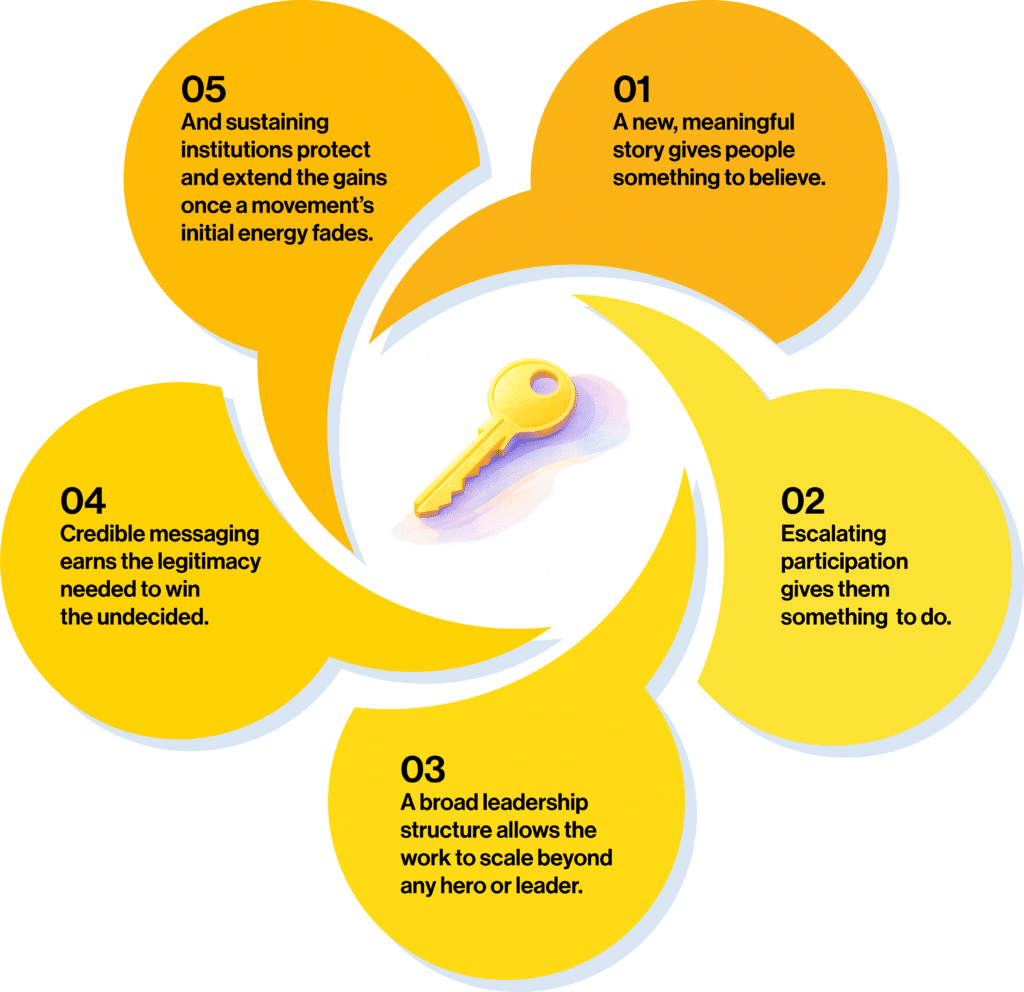
These keys form a reinforcing system. Participation generates stories that feed meaning. Structure maintains momentum and enables legitimacy. Institutions protect and extend gains through rituals and practices. When all five are present, movements build momentum and create change. When even one is missing, the movement stalls.
Key 1: New meaning creates motion
Movements succeed when they reframe. They don’t start with action. They start with a story that changes how people see an issue. The most powerful movements reframe the topic, changing what’s at stake and who is implicated.
In the 1950s, over 40% of American adults smoked. The tobacco industry spent decades framing cigarettes as symbols of sophistication and personal freedom. On the other side of the equation, public health leaders communicated the harms of tobacco by repeatedly bringing to light the alarming statistics. The public health movement, named the Tobacco Control Movement, only began to win when it changed what smoking meant to the public. It reframed smoking from a personal lifestyle choice to a public health threat that endangered everyone beyond the smoker. The Surgeon General’s 1964 report was a trigger, but the real work was decades of reframing, from “your choice” to “our health” that eventually cut smoking rates down to 12%.
The same mechanism is visible today. When “climate change” became “climate crisis,” public urgency increased. Two words. Different frame. Different response.
A new frame is necessary, but a frame alone is not enough. Once people see the world differently, they adopt the belief and act.
Key 2: Clear plans of action turn belief into behavior
Movements are built on ladders of action, not leaps of inspiration. The difference between a campaign and a movement is simple: campaigns ask for agreement; movements ask for action. Campaigns collect opinions; movements create behaviors. And those behaviors spread when there’s a clear next step — each rung leading to a deeper commitment.
The Montgomery Bus Boycott is often reduced to a single act of Rosa Parks refusing to give up her seat. But the real story is what happened next. For 381 days, over 40,000 black residents of Montgomery organized carpools, private taxi services, and fundraising networks rather than ride segregated buses. The Montgomery Improvement Association created clear roles and systems for thousands of participants. The logistics behind the boycott converted thinking into doing.
The Ice Bucket Challenge is the cautionary tale. Millions poured ice water over their heads for ALS research, raised $115 million, and helped fund a scientific breakthrough. The frame was brilliant. The participation was massive. But the design had no second step. There was no ladder from pouring ice to volunteering to advocating to leading. As a result, some critics decried the effort as “slacktivism.”
A ladder of action works if there is someone to build it, maintain it, and extend it as the movement grows. That requires more than a visionary founder. It demands a leadership structure that can operate without any single person at the center, which is what separates movements that spread from those that collapse when a visible organizer is removed.
Key 3: Broad leadership structure enables scale
Movements that depend on a single leader or a single moment cannot scale. The ones that endure build distributed leadership, repeatable models, and infrastructure. Heroes generate inspiration and catapult a vision into the world. But it is the work of many lieutenants, who are equipped, and working in coordination, that carries a movement from one room to fifty nations.
In the late 1990s, a group of Serbian university students founded Otpor!, meaning “Resistance!”, a movement to overthrow the authoritarian regime of Slobodan Milošević. They had no charismatic leader, and that was the point. Otpor! trained thousands of local activists using a decentralized “snowflake” model, where each cell had local autonomy but shared branding, tactics, and training. When the regime arrested one activist, ten more were ready to step in. The movement could not be decapitated. In October 2000, Milošević fell. The founders later created CANVAS, exporting their structural methodology to activists in over 50 countries, proving that the approach itself was replicable.
The Arab Spring in Egypt illustrates what happens when a resilient leadership cadre is thin or absent. In January 2011, hundreds of thousands filled Tahrir Square and toppled President Mubarak in just 18 days. The participation was massive and the initial legitimacy was real. But the movement had no figureheads to coordinate a democratic transition and no institutional plan to protect what it had won. The military filled the vacuum. Within two years, a coup installed a new authoritarian government. Tahrir Square proved that mobilizing people is one challenge. Having guiding voices to sustain and organize what they build together is another entirely.
Structure allows a movement to act at scale, but scale alone does not necessarily persuade the people a movement still needs to persuade. The hardest audience is not the opposition. It is the large middle of people who may be watching from the sidelines, unpersuaded and undecided. Winning them requires something different from an organization driving a movement. It requires legitimacy.
Key 4: Credible messaging wins the undecided
The broader and more ideologically diverse the coalition, the more inevitable the cause becomes. Movements succeed when they win the moveable middle. Energizing the base matters, but it is rarely what tips the scale. What makes the difference is the credibility of a coalition too diverse to dismiss — one that delivers an honest message, acknowledging challenges and progress. The message rings true because undecided people see it as coming from peers.
In late 2016, a corruption scandal engulfed South Korean President Park Geun-hye. Over the following five months, what became known as the Candlelight Movement saw millions of citizens hold weekly peaceful vigils across the country. The protesters were strikingly diverse, spanning students, workers, families with young children, elderly citizens, professionals, and religious groups. That breadth made it impossible to dismiss the movement as fringe or partisan. The diversity of participants was the argument. The Candlelight Movement did not end in revolution but in constitutional impeachment, an outcome that strengthened the legitimacy of both the cause and system itself.
When a broad, surprising coalition causes a movement to feel inevitable, they win. But winning the argument is not keeping and securing the gain. Energy fades. Attention moves on. New leaders arrive with different priorities. What endures depends on the final condition. The one most often ignored.
Key 5: Institutions make it last
The ultimate test of a movement is what happens when the energy fades. Whether the gains survive depends on what outlasts its leaders. Institutions convert energy into permanence, embedding gains in laws, organizations, and rituals.
The Labor Movement offers the clearest example. Over more than a century, it did far more than win strikes. It built enduring institutions that outlasted the individual issues and fights at the time. Unions created collective bargaining as an ongoing mechanism. The Wagner Act codified the right to organize into federal law. And the demands that once seemed radical, the eight-hour workday, the minimum wage, workplace safety standards, became embedded in law and culture that most people today don’t remember they were controversial.
In countries where labor movements maintained institutional strength, such as Germany, the Nordics, and parts of East Asia, workers continued to secure gains for the middle class over decades. In the United States, where union membership declined sharply from the 1970s onward, income inequality widened in tandem. The contrast suggests that institutionalization isn’t a one-time achievement. It requires ongoing defense and renewal. Even the strongest institutions erode when they are no longer maintained.
Occupy Wall Street stands as the counterpoint. In 2011, “We are the 99%” gave America a new vocabulary for inequality and inspired occupations in more than 900 cities. But the movement explicitly rejected formal organization, policy demands, and institutional strategy. When police evicted the camps, there was no organizational structure to carry the work forward and no institutional footprint to protect what had been built. The frame was powerful. The participation was real. But without institutions, the energy dissipated and only fragments survived.
When the change becomes invisible because it’s a new baseline, the movement has done its deepest work. That invisibility is itself the measure of institutional success. When no one thinks to question it anymore, the change has become the air people breathe.
Questions at the start
These five keys are more than lessons from the past. They’re a diagnostic for any leader trying to mobilize people.
A leader looking to launch a movement should ask a few questions:

Key 1: New meaning creates motion
Can your people retell your story in their own words, and does it travel without you?

Key 2: Clear plans of action turn belief into behavior
Is there a clear first step tomorrow, and a path from that step to deeper commitment?

Key 3: Broad leadership structure enables scale
If the top leader left, do others have the tools and authority to act?

Key 4: Credible messaging wins the undecided
Who outside your core team would vouch for the effort, and are your messengers credible?

Key 5: Institutions make it last
If the initiative ended tomorrow, what systems would remain to guide how people behave?
The pattern holds across every case we’ve studied: remove even one pillar and movements stall, dissipate, or reverse. The keys aren’t optional. They’re the architecture.
At BrightHouse, we know these keys on sight. We’ve seen them inside organizations and communities. We’ve observed what happens when leaders skip them: there is a meeting that lands, a memo that resonates, an initiative that flickers and disappears within a year.

Design:
Natalie Gramling, Sr. Art Director, BCG BrightHouse