Why we Invite Divergence
In the past decade, technology has collapsed the distance between expertise and opinion. As a result, sameness is easier to find, and difference easier to avoid. Algorithms tailor what we see. Hierarchies reinforce who we hear. Even in well-intentioned workplaces, teams risk mistaking consensus for clarity.
To think differently, we must first listen differently. That’s why, at BCG BrightHouse, we bring Luminaries, subject matter experts that are part of our curated BrightHouse network, into our creative and consulting practice to challenge our thoughts and expand our perspectives.
Luminaries are thought leaders who challenge how we see the world and each other. This year, we had an incredible season of luminary workshops that inspired us to deepen our perspective, and we would like to share their learnings here.
Each session was more than an event: it was an intervention in how we think. A poet taught us to embrace imperfection as a path to creativity. A psychologist reminded us that kindness is not sentiment, but strategy. An executive coach turned inclusion from a concept into a daily behavior.
Together, they demonstrated something profound: when organizations make space for voices that challenge, inquire, or inspire, they unlock new ways of seeing, and with them, new pathways for action.
How Constructive Tension Creates Cognitive Flexibility
Most organizations aspire to think boldly, but don’t operate in ways that make bold thinking easy. Alignment and efficiency can drive performance, but without dissent and depth, success is short-lived.
The paradox is that the very traits that make teams high-performing in the short term, can inhibit long-term exploration and innovation. When people anticipate the “right answer” or the “expected view,” the invisible walls of groupthink rise, brick by beige brick, around them. What’s lost is not capability, but possibility.
At BCG BrightHouse, we’ve seen that great breakthroughs emerge from constructive tension. When perspectives make room for each other, ideas get bigger. Done well, this isn’t conflict. It’s chemistry. Exposure to new ideas and unexpected voices broadens our mental models, leading to deeper insight and more original solutions.
Organizations that invite outside thinkers, or even internal contrarians, are more likely to adapt with imagination. They develop what we might call cognitive flexibility: the ability to stretch their thinking and form new neural pathways.
How our luminaries shifted our perspective
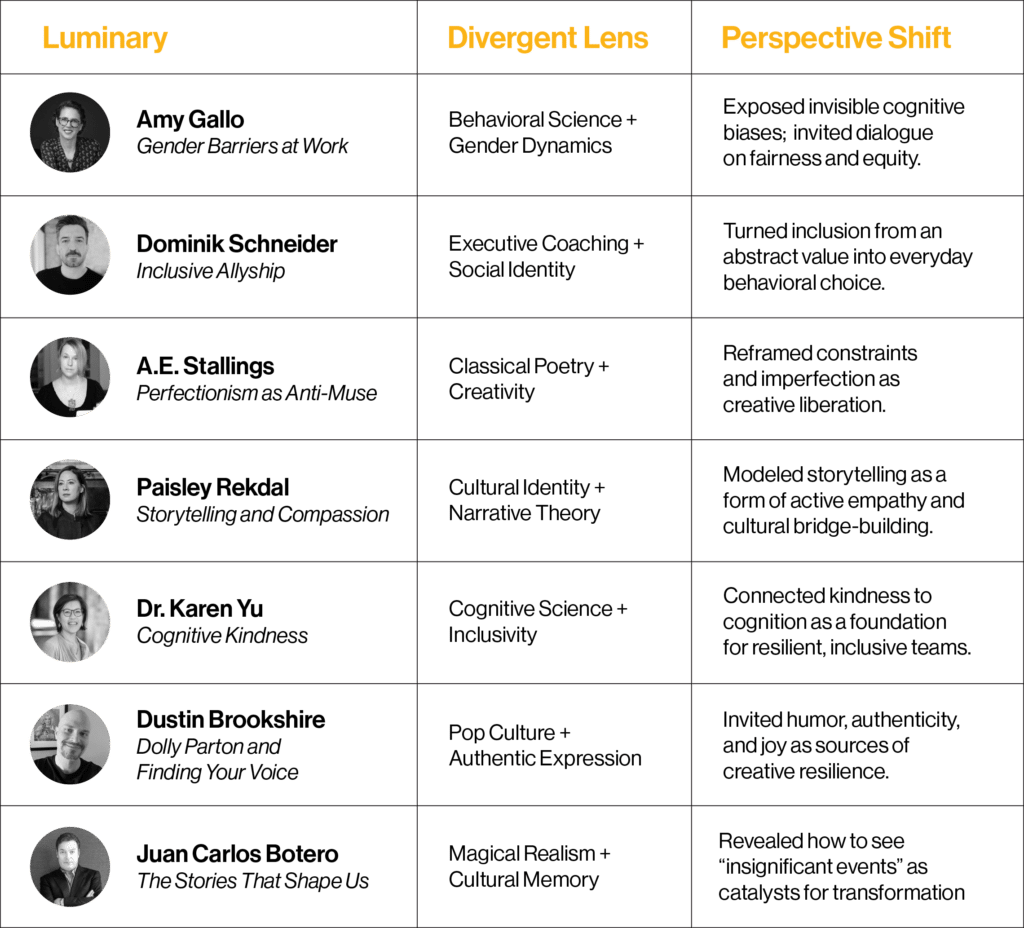
Bringing in a Luminary is not simply hosting a guest speaker; it’s inviting a perspective shift. In 2025, BrightHouse welcomed a remarkable group of thinkers:
Amy Gallo — The Courage to Name What We Don’t See
Disagreeing calmly and competently navigating conflicts is not just a work skill, it is a life skill
Amy Gallo from her Tedx Talk, The Gift of Conflict
Bestselling author and workplace dynamics expert Amy Gallo joined us to explore The Double Bind: the invisible gender barriers that shape how people are heard and valued at work.
Amy challenged us to look beyond good intentions and examine how even progressive teams can perpetuate inequities through tone, language, and assumptions. She reminded us that allyship begins not in defense, but in discomfort: the willingness to stay in a difficult conversation long enough to learn something true.
Dominik Schneider — Allyship as Everyday Architecture
Allyship is not a single act. It is a process with 5 different stages: absent, aware, accepting active and advocate.
Dominik Schneider
Executive coach and founder of Beyond Alpha, Dominik Schneider, reframed inclusion not as a program, but as a practice. In his session on Driving Inclusive Allyship, he helped us translate values into actions that make belonging visible.
He encouraged us to “make space for every voice,” to ask better questions, and to hold ourselves accountable for inclusivity. The energy in the room made it clear: when inclusion moves from intention to action, culture changes.
A.E. Stallings — The Freedom Within Constraint
Constraints liberate. Rules reduce choice paralysis and spark play… they’re like a sourdough starter for ideas.
A.E. Stallings
Pulitzer Prize finalist and Oxford Professor of Poetry A.E. (Alicia) Stallings led a workshop titled Perfectionism as Anti-Muse. Through poetry and play, she showed us that creative freedom is not the absence of limits, but the art of working within them. Constraints, she argued, sharpen imagination by forcing the mind to explore unexpected paths.
Her provocation to “trust the rough draft” resonated beyond the page. It became a metaphor for organizational creativity: that progress often begins where perfection ends.
Paisley Rekdal — Storytelling as an Act of Compassion
I think of kindness as sharing memory… one culture can powerfully remember another culture’s stories and preserve them when they’ve been lost within their own communities.
Paisley Rekdal
Poet and cultural historian Paisley Rekdal guided us through the moral dimension of storytelling. Her session revealed that narrative is not only a vehicle for persuasion, but also a practice of empathy: a way of giving voice to silenced histories and honoring the complexity of identity.
She reminded us that compassion is not a soft skill; it is a disciplined act of attention. To tell a story well, one must listen deeply, a lesson that applies as much to leadership as to literature.
Dr. Karen Yu — Kindness as Cognitive Strength
A cognitively kind approach that genuinely values each person’s thinking can go a long way.
Dr. Karen Yu
Our current Luminary Fellow Dr. Karen Yu introduced the idea of cognitive kindness (being kind to each other’s minds). In a culture that prizes speed and precision, Dr. Yu challenged us to design processes and interactions that lighten mental load and enhance clarity.
Her insights connected neuroscience to inclusion, showing that when we protect attention, respect differences in thinking, and create room for reflection, we elevate performance. Her message was simple but profound: kindness is not a luxury, it’s a competitive advantage.
Dustin Brookshire — Finding Voice Through Joy
The songs of legendary singer-songwriter Dolly Parton can teach us about writing, craft, and perspectives in poetry.
Dustin Brookshire
Queer poet and editor Dustin Brookshire invited us into the unexpected world of Dolly Parton and Poetry. Through writing prompts inspired by Dolly’s songs, he reminded us that voice is born from connection. His session celebrated the power of joy, humor, and resilience as creative tools.
In an often-serious world of business strategy, Dustin’s workshop made space for levity. We learned that laughter can reconnect teams to purpose and possibility.
Juan Carlos Botero — Storytelling, Chance and the Fragility of Being
Insignificant events don’t exist.
Juan Carlos Botero
Colombian novelist and essayist Juan Carlos Botero invited us into the deeply human terrain where memory, chance, and narrative intersect. Through stories drawn from his own life, he shared how a single overlooked moment can redirect a life or an entire country. His reflection revealed a core truth of his work: that the fragility of existence is not a flaw, but a force. It’s a reminder that what seems small can alter everything.
Botero reminded us that storytelling is both discipline and illumination: a daily struggle with language that becomes a pathway to meaning. He urged us to look closer at the events we often dismiss, and to recognize them as catalysts for transformation. This awareness of life’s delicate architecture offers a powerful lens for divergent thinking. When we zoom in on the subtle, we unlock entirely new ways of seeing the whole.
Divergent Thinking as a Competitive Advantage
Across every insight runs a simple thread: divergence makes us more whole. When people with different minds, backgrounds, and disciplines share the same table, they help each other recover parts of their own thinking they’ve left unused.
As we face increasingly complex challenges, from AI ethics to the climate crisis, it’s precisely difference that becomes our most renewable resource. Divergent voices help us see the unseen: the assumptions beneath the data, the nuances within the strategy, the stories behind the system.
In a time when technology accelerates thinking, divergence teaches us to deepen it. And that may be the most human strategy of all.

Design:
Natalie Gramling, Art Director, BCG BrightHouse